What Is Audiovisual Digitisation? A Complete Guide to Preserving Video & Audio (2026)
There’s probably a box somewhere in your building a cupboard, a storeroom, the bottom of a filing cabinet with old tapes or film reels in it. And here’s the uncomfortable truth: that stuff is slowly dying. The tapes weren’t built to last, and the machines that play them are basically going extinct. Audiovisual digitisation is the thing that gets in the way of all that being lost for good.
So if you look after a pile of video, audio, or film and you’re not quite sure what to do with it, this is meant to help. What digitisation actually is, how it works, and why 2026 is not the year to keep putting it off.
Suggested image: A close-up of old magnetic tape reels and film canisters sitting on archive shelving, soft lighting. Try searching “vintage film reels archive” on Unsplash or Pexels you’ll find something royalty-free that isn’t the same tired stock photo everyone uses.
What Is Audiovisual Digitisation?
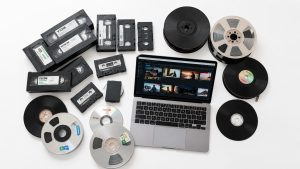
Put simply, it’s converting old recordings videotapes, audio cassettes, vinyl, open-reel tape, motion picture film, all of it into digital files you can actually store and use on today’s systems.
The way I’d describe it: the sound and pictures are trapped inside media nobody can play anymore, and digitisation gets them out and into safe digital copies. Usually that means two things get made. A preservation master, which is the high-res archival version, and lighter access copies you’d use for watching, sharing, sticking online, whatever.
But this matters, it’s not just about hitting records and making a copy. Done right, digitisation holds onto the quality and the context of the original so it still means something in twenty, thirty years. That’s the part people underestimate, and it’s why you really want someone who knows both the fragile old media and the standards that keep digital files from quietly rotting later.
Why Digitisation Matters More Than Ever in 2026
Two things are working against these collections, and neither is getting better with time.
First, the media just decays. Magnetic tape gets sticky-shed syndrome. The layer holding the recording literally starts coming apart and sheds when you play it. Film has its own problems: vinegar syndrome, mold. And every year a tape sits in a box untouched, your odds of pulling a clean recording off it get worse.
Second, and this one sneaks up on people, the machines are disappearing. U-matic, Betacam, DAT, MiniDV. Nobody makes the players anymore. Worse, the handful of technicians who can actually keep them running are hitting retirement age. Doesn’t matter how well you’ve stored a tape if there’s nothing left on earth to play it back on.
UNESCO and a lot of archives have been sounding the alarm on this for a while: magnetic tape that doesn’t get digitised in time is probably just gone. So when you digitise video audio collections now, you’re racing a clock one that doesn’t stop and doesn’t reset.
How the Audiovisual Digitisation Process Works
Every collection’s a bit different, but the general shape of the work tends to look like this.
1. Assessment and Preparation
Everything gets looked at first what format it is, what condition it’s in, how risky it is to play. Some tapes are too fragile to just throw on a machine, so they’ll need cleaning, repair, or baking beforehand. This is also where the genuinely damaged stuff gets flagged for special handling.
2. Signal Capture
Then the item gets played on the right calibrated gear and captured as it goes. And here’s the thing people don’t expect: it’s real time. A two-hour tape takes two hours. No fast-forwarding through it. The settings someone picks at this stage basically decide the quality of everything downstream, so it’s not a step to rush.
3. Creating Masters and Access Copies
Out of that capture you get the archival-grade preservation master, plus the everyday access versions. Worth knowing: video eats up something like 100 times the storage of audio, second for second. So figuring out storage isn’t an afterthought, it’s part of the job.
4. Metadata and Quality Control
Files get checked for errors, then tagged with metadata the descriptive info that makes anything findable later. Skip this and you can end up with a perfect file that’s effectively lost, because nobody can locate it.
5. Delivery and Long-Term Storage
Finally the finished files come back to you and get wrapped into a proper plan for ongoing digital preservation kept organised and authentic so they’re still usable down the track.
Digitisation, Data Migration, and Digital Restoration: What’s the Difference?
People mix these up constantly, but they’re not the same thing.
Digitisation is the analogue-to-digital bit. Data migration services are different, that’s about rescuing stuff that’s already digital but stuck on carriers that are about to die: old hard drives, optical discs, weird proprietary formats. If your so-called digital archive is a shoebox of burned DVDs from 2005, that’s a data migration job, not digitisation.
And then there’s digital restoration, or digital video restoration, which goes a step past just preserving. Once something’s digitised, you can knock back the noise, fix faded colour, steady shaky footage, clean up the hiss and clicks and hum. It doesn’t just save the recording, it kind of brings it back, and honestly it often ends up looking and sounding better than it ever did the first time round. Have a look at how content modernisation pulls these techniques together.
String all three together digitisation, migration, restoration and you’ve got the full run from fragile old things to something ready for the future.
Who Needs Audiovisual Digitisation?
Honestly, more people than you’d think. A digital preservation service tends to work with:
Libraries, archives, and museums looking after cultural and heritage material including recordings that genuinely can’t be replaced, like Indigenous ones.
Broadcasters and production houses sitting on big tape libraries they want to reuse.
Universities holding onto research and teaching recordings.
Government and corporate bodies with compliance and long-term access obligations.
Smaller outfits with collections that are modest but still matter to them.
Different sizes, different sectors, same underlying problem though: if it only exists on decaying physical media, it’s at risk. Full stop.
Choosing the Right Digitisation Partner
Not everyone offering this is equal, and it’s worth being a bit picky. You want an actual specialist not a duplication shop or a post-production place that does a little digitisation on the side. Things I’d check: do they know the obscure old formats, do they stick to archival standards, can they actually recover fragile and damaged media, is their metadata and QC any good, and can they be trusted with sensitive collections.
A good partner treats your collection like it’s irreplaceable because, well, it is. You can get a sense of how a specialist handles this kind of work over on the DAMsmart homepage.